
Seal Beach Previous Residents Across Eras
Previous residents of a Seal Beach address appear in different record families, and each family answers a different part of the question. The recorder can show a transfer. A directory can place a named householder at a street address. A census can show family relationships on one date. Permits can date a change to the structure without proving who lived there. The era map below keeps those roles separate, so a clean title chain is not mistaken for a complete list of people.
| Source | Years It Covers | Where Held | What It Shows |
|---|---|---|---|
| RecorderWorks grantor/grantee index | 1982-present | Orange County Clerk-Recorder online | Party names, type, recording date, document reference; no web image |
| Recorded deed and index books | Before 1982; usable book run to confirm | Orange County Clerk-Recorder offices and index-book browse | Earlier grantor/grantee chain, legal description, book/page/instrument |
| Orange County Archives volumes | Deeds 1889-1926; index volumes 1889-1953 | Orange County Archives and microfilm | Original county property backbone and an older research fallback |
| Federal population census | Decennial schedules through 1950 publicly accessible | NARA 1950 portal and genealogy partners | Named occupants, relationships, and household facts on census dates |
| Seal Beach building and planning records | Earliest permit-card year not published | Seal Beach Community Development and city repository | Construction and alteration chronology; owner or applicant on some files |
| City and reverse directories | Exact Seal Beach title and year run not verified | OC Public Libraries and local-history collections | Address-to-occupant and name-to-address entries where the locality appears |
| Sanborn fire-insurance maps | No dedicated Seal Beach years verified; nearby 1908 Long Beach volume | Library of Congress and library databases | Building footprints, use, and materials where mapped; not ownership |
| Assessor parcel maps and current roll | Current; historical material depends on office holdings | Orange County Assessor and OC Public Works | APN, boundaries, assessee, values and characteristics; mailing versus situs |
The gaps are part of the method. Exact Seal Beach directory titles and year runs were not verified in accessible OC Public Libraries holdings, and no dedicated Seal Beach Sanborn volume was confirmed. Ask the named repository for the actual volume, film, or map before stating a date. For older land, the archive row matters because Orange County was created in 1889 from Los Angeles County, so a prior record may sit under an earlier custodian or place name.
Note: A missing directory entry can reflect a move, an index variation, a new tract, a name change, or a shifted street label.
APNs for Seal Beach Previous Residents
Start with a current situs address, but do not let the street number carry the whole history. The Orange County Assessor property gateway points to parcel information and maps, while the free secured-value screen uses one key: an APN with eight numeric digits. That screen omits the owner name and states that California law does not allow owner-name searches there. Copy the APN exactly, preserve the parcel map or legal description, and note the assessment-roll date. The most recent annual roll can lag later changes.
Open the parcel in OC Land Insights and retain the tract, lot, block, survey, annexation, and cross-street clues shown by the map. The map can supply boundaries, document layers, flood parcels, and measurement tools, but it does not publish a resident name. The Orange County tax search also accepts a property address, APN, or tax-default number; a tax bill identifies a parcel and tax status, not who lived there.
Address → APN → legal description → current assessee → recorded instrument → prior grantor.
Seal Beach Previous Residents in RecorderWorks
From 1982 to present, the free Orange County RecorderWorks grantor/grantee index is keyed to parties rather than street addresses. Search the current assessee, try LAST FIRST and spelling variants, narrow the date range, and filter toward Grant Deed, Quitclaim Deed, Trustees Deed, or another conveyance. A document-number link opens the index record. A party-name link can pivot to that name's indexed documents, sorted by type and recording date.
| Search field or control | Type | Required | Format or use |
|---|---|---|---|
| Grantor/Grantee name | Text | Search-dependent | Name-index route; try spelling variants and corporate names |
| Recording date range | Date pair | Search-dependent | Narrows common names; exact coverage start is not stated on the copy guide |
| Document number or instrument reference | Text | No | 1982-forward convention is recording year plus six digits |
| Book and page | Numeric/text pair | No | Especially relevant to records before 1982 |
| Search | Button | Yes | Runs the index query |
| Clear/Reset | Button | No | Clears criteria when exposed by the live interface |
The official copy instructions explain the difference between an index hit and a document image. The captured recorder page states that the web search returns an index only, staff do not perform searches by phone, in person, or by mail, and copies must be ordered after the researcher finds the reference.
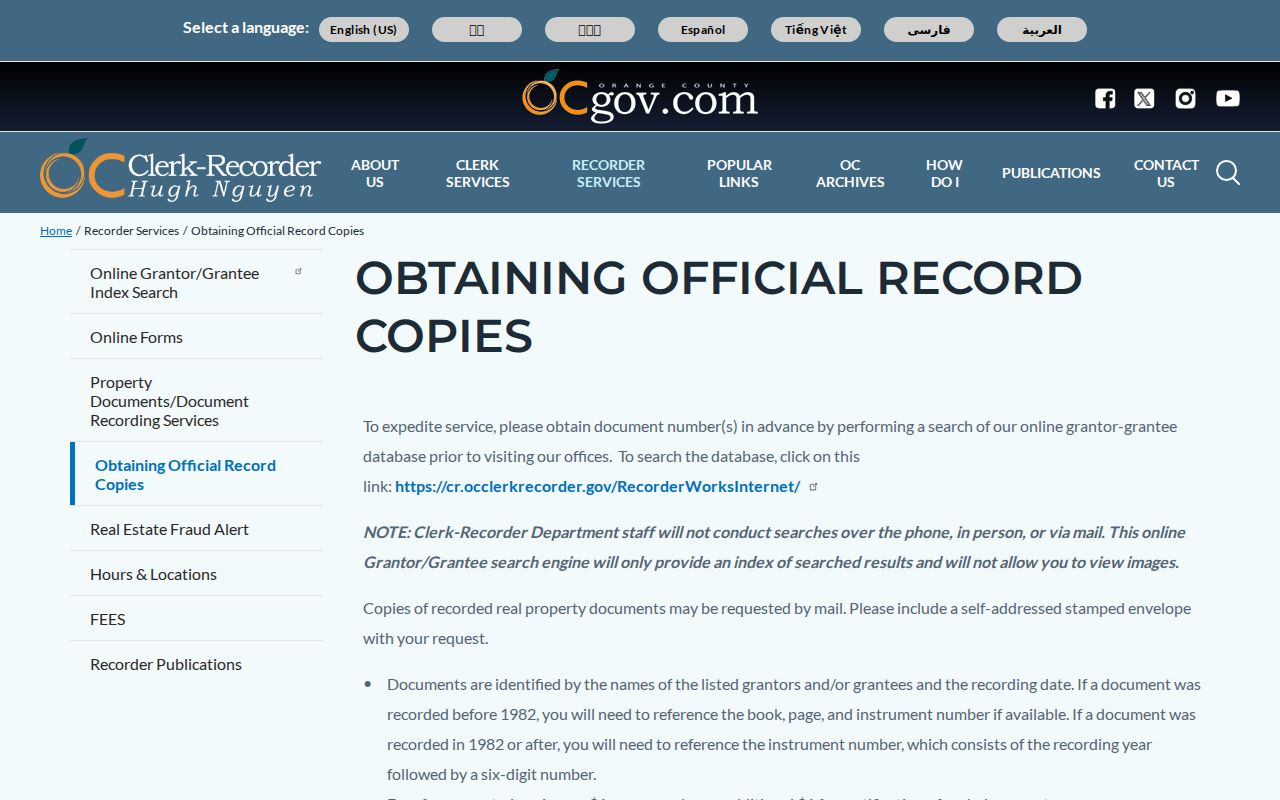
For a Seal Beach previous-residents search, that boundary prevents a promising party name from being treated as proof until the underlying recorded instrument is viewed or obtained.
Seal Beach Previous Residents Before 1982
The pre-1982 boundary changes the identifier and the access path, not the age of the land record. For an older recording, the county's copy guidance asks for book, page, and instrument number if available. For 1982 and later, the instrument number uses the recording year followed by a six-digit number. Record the last known reference before crossing the boundary, then carry the party names, approximate years, tract, lot, block, and legal description into the index-book or office search.
Public viewing at a Clerk-Recorder location can be useful before paying for copies. A mail request requires a self-addressed stamped envelope, $1 per page, and an additional $1 to certify each document or map, payable to County of Orange. Requests go to Orange County Clerk-Recorder, 601 N. Ross Street, Santa Ana, CA 92701; procedural questions use 714-834-2500. The researcher must supply the document reference, because the office does not conduct the historical search.
Note: Do not pay for a certified copy until the index reference is complete and the requested document can be identified by the custodian.
Seal Beach Deed Chain for Previous Residents
A backward title trail begins with the current parcel and moves through both sides of each conveyance. Search the current owner as a grantee, find the purchase deed, then treat the seller or grantor on that deed as the next prior owner. Trust deeds and reconveyances help explain financing chronology, but they are security records and do not automatically transfer title. Common names require the APN, legal description, spouse or co-owner, tract, and recording date as checks.
- Stabilize the parcel. Copy the current situs, APN, assessor details, and the legal description from the map or deed reference.
- Find the latest acquisition. Search the current owner or entity in RecorderWorks and narrow by recording dates and conveyance type.
- Capture both parties. Record the grantee, grantor, document type, recording date, document number, and book/page or instrument reference.
- Pivot to the seller. Search that grantor again as a grantee, using LAST FIRST or a partial match, then compare the parcel and tract.
- Cross the old boundary. Repeat until the web index ends, then move to deed books, microfilm, or an office viewing with the last known reference.
Every step should preserve the source date and the exact parcel language. A same-name result that lacks the subject legal description is a lead, not a confirmed predecessor.
- Grantor / grantee
- The grantor transfers an interest; the grantee receives it. In a purchase deed, the seller is usually the grantor and the buyer the grantee.
- Chain of title
- A linked sequence of recorded transfers that connects a present title interest to earlier parties.
- Legal description
- Formal parcel language, such as a tract, lot and block, parcel map, or metes-and-bounds description, that can survive a street-label change.
- APN
- An Assessor Parcel Number used to identify the county parcel. It is a parcel key, not a complete list of people associated with the address.
- Situs address
- The physical location of the parcel, distinct from a mailing address used for tax or assessment correspondence.
- Criss-cross directory
- A reverse directory arranged by street address instead of surname, connecting a house number to a published householder for a particular year.
- Enumeration district
- A census area assigned to an enumerator. Its map and description can help locate a street when the written address is hard to read.
Seal Beach Directories and Census Households
A deed trace finds owners, but former residents may appear only in household sources. A conventional city-directory entry can show a surname, given name or initial, spouse notation, and residence address. A reverse or criss-cross directory starts with a street and house number, then names a householder or subscriber for that year. Publishers use different keys, so read the volume's abbreviation page before treating a mark as proof. The exact Seal Beach title and year run was not verified in accessible holdings.
The Seal Beach-Mary Wilson branch and the California State Library's genealogy service are the appropriate places to ask about shelved, microfilmed, or remote-storage volumes. The collections themselves belong with the Seal Beach city directory collections; the previous-residents question uses a specific entry as one link in an address trail.
Pair the directory and census evidence in a fixed order:
- Copy the directory year, name, address, initials, spouse notation, and nearby entries exactly as printed.
- Compare the closest released census schedule, checking the street, household relationships, ages, and place details available for that year.
- Read the next directory before and after the census date, including reverse pages, to bracket moves or a changed householder.
- Test the household clue against the deed chain, permits, obituary, or probate record, and label it confirmed, possible, or unresolved.
Federal population schedules are publicly accessible through 1950 under the 72-year rule. The 1950 Census search offers images and name searching, with enumeration-district maps and descriptions that help when an address is hard to read. A missing entry can reflect a move, death, name variation, new subdivision, cross-reference, or enumeration timing. A yearbook, directory, released census household, and obituary can still reconnect a former classmate or family line when no single source is complete.
Seal Beach Past Residents Across Bay City and 1915
Seal Beach was called Bay City before incorporation in 1915. An older address search should test both place names and keep the Orange County and Los Angeles County boundary in view. Orange County was formed from Los Angeles County in 1889, so the earliest land trail may require county, state-archive, or land-grant sources outside a modern Seal Beach search. Carry the tract, lot, block, legal description, and nearby cross streets instead of relying on the city label alone. State county-record guidance can help identify the older custodial layer.
Local development creates more breaks. City history records the 1944 Navy installation, the removal of more than 300 beachside homes, the Hill subdivisions opening in 1957, and Leisure World's opening in 1962. If a house number disappears between directories, the cause may be federal acquisition, demolition, or a tract that had not yet been built. The city history and budget record supplies the chronology without turning a gap into a guessed occupant.
Seal Beach Permit Records and Occupant Clues
Building and planning files can date the structure when a directory is silent. Search the Seal Beach public document repository for the exact address, APN, project term, and year. Its OCR-searchable council, planning, ordinance, and resolution records may connect an address to a permit, sign review, tract-map dispute, appeal, agenda correspondence, or meeting minutes. Older scans can misread characters, so browse the year and document family as well as the text result.
Permit files may name an applicant, owner, architect, or contractor and can show construction, additions, demolition, or alteration dates. They do not establish every occupant. If a permit card or closed file is absent, ask Seal Beach Community Development for a narrowly defined address and date range through the California Public Records Act. Utility connection dates can help date a structure, but customer identities and account lists are not a substitute for a lawful resident record.
Seal Beach Resident History and Sanborn Context
Sanborn fire-insurance maps are a nearby-context tool. They can show building footprints, use, construction material, and street geometry where a sheet covers the parcel, but they do not establish ownership or occupancy. The Library of Congress 1908 Long Beach volume includes Alamitos; that does not prove that a particular Seal Beach parcel is mapped. No dedicated Seal Beach or Bay City Sanborn volume, or exact Seal Beach sheet years, was verified.
Use the Library of Congress catalog's advanced search under Seal Beach, Bay City, Anaheim Landing, and nearby Long Beach or Huntington Beach names. Ask the Seal Beach-Mary Wilson reference desk about local databases before assigning a map to an address. Compare any sheet with the legal description, lot shape, street alignment, directory year, and permit date, and mark nearby-map evidence as context rather than proof.
Note: A nearby Sanborn sheet can clarify context, but it cannot prove that a particular Seal Beach parcel appears on that sheet.
Seal Beach Previous Residents in Archives
When a web chain reaches pre-1982 records or the county-creation seam, Orange County Archives is the named fallback. The Clerk-Recorder reports 640 original property-deed volumes dating from 1889-1926 and 210 property-index volumes from 1889-1953 converted to microfilm. Most Archives holdings date before 1960. The research room is Room 108, 211 W. Santa Ana Boulevard, Santa Ana, open Monday-Friday from 9:00-noon and 1:00-4:30, closed noon-1; the phone is 714-834-2536. Check the Archives directions before a visit.
Bring party names, approximate years, tract or legal description, and every book/page reference already found. The archive is a place to inspect the older record trail, not a promise that staff will build it for the requester. The paper backbone also explains why a failed modern name search does not end a Seal Beach previous-residents inquiry.
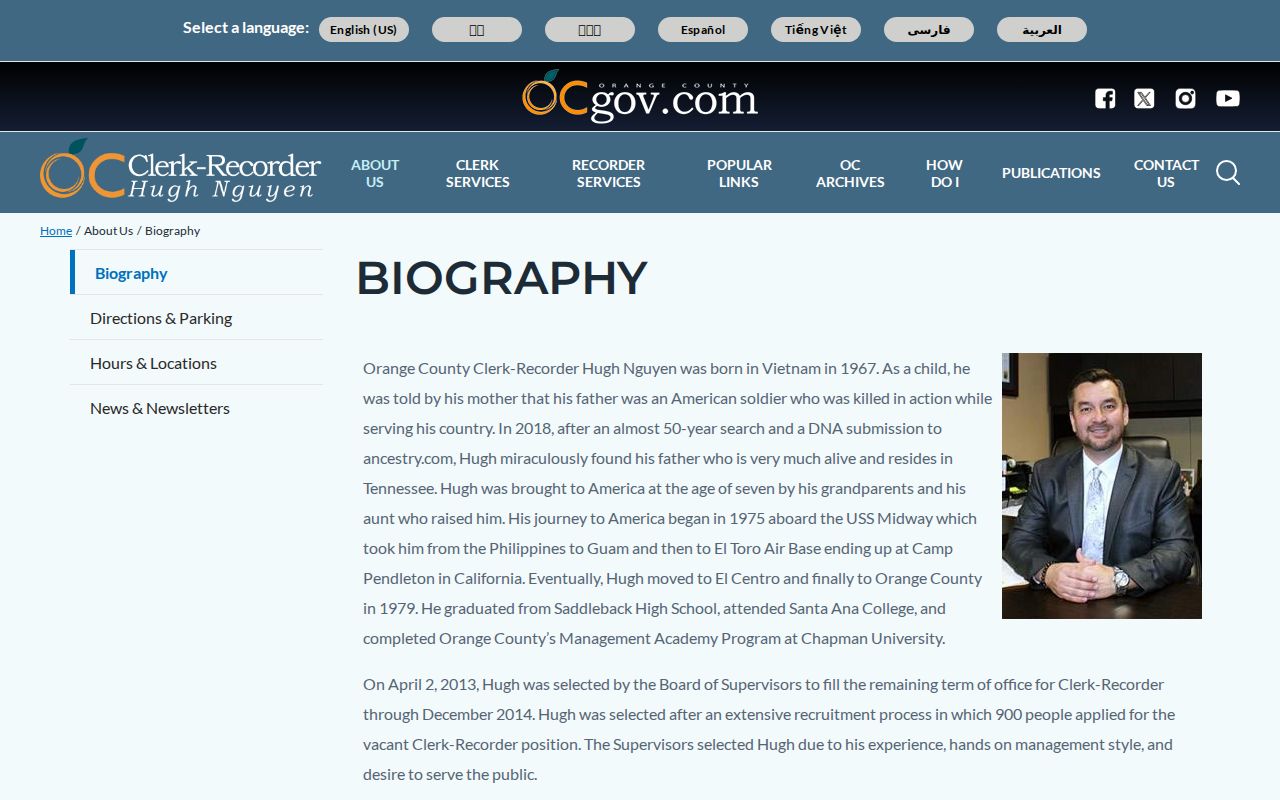
The Orange County Clerk-Recorder biography places that archive history in the county's record-keeping story.
Obituaries and probate can close a trail after a former owner died. A death notice may connect an address-era name to relatives or former residences, while probate may identify a personal representative or heirs. Neither proves that a listed relative occupied the parcel. Use a later grant deed, trustee's deed, decree or distribution record, or current assessment record for the next title step.
Seal Beach Previous Residents: Owners and Occupants
A careful house history labels what each record actually proves. A deed identifies a title transfer. An assessor record gives an assessee and annual roll context. A directory names a householder or subscriber for a printed year. A census describes a household on its enumeration date. A permit identifies a project participant. An obituary supplies family context. Probate names estate roles. These are related clues, not interchangeable proof.
Keep a short evidence log with the source, exact date, address, APN, legal description, document reference, and confidence level. Separate confirmed title steps from possible occupants, and verify a consequential record with the office that holds it. Past-resident research is strongest when it explains uncertainty instead of filling a gap with a same-name guess.
Lawful house history. Use Seal Beach previous-residents records for genealogy, family history, reconnecting with a former classmate, or understanding a property's recorded past. Do not use records to stalk, harass, monitor, or harm a living person, and leave protected addresses and confidential data private.