
Seal Beach City Directory Holdings
Seal Beach directory research sits at the edge of Long Beach and Orange County publishing markets. A catalog-first search should test Seal Beach, the older name Bay City, Orange County, and Long Beach-area suburban directories before treating a hit as local. The accessible research does not verify a complete publisher list or a first and last year for a Seal Beach-specific run. That gap matters. A volume may be shelved, on microfilm, in remote storage, or described only by a broader county or regional title.
| Collection | Years | Where Held | Access |
|---|---|---|---|
| Seal Beach, Orange County, and telephone directories | Exact titles, publishers, and volume years are not verified | OCPL catalog and Seal Beach Mary Wilson reference desk | Ask about shelved, microfilmed, and remote-storage holdings |
| California city and county directories | Repository-specific runs | California State Library | Catalog by place and publisher; reference request or in-person use |
| Federal population census | Decennial schedules 1790-1950 nationally; local coverage follows boundary years | NARA 1950 portal and genealogy partners | Name, relationship, age, birthplace, occupation, and street or address fields vary by year |
| Historic newspapers | Title-specific | Chronicling America, the Library of Congress newspaper directory, and OCPL databases | Obituaries, marriage notices, visitors, legal notices, and society columns |
| California digital images and ephemera | Collection-specific | Calisphere | Search Seal Beach, Bay City, streets, schools, and organizations |
| California vital and county genealogy collections | Collection-specific | FamilySearch California | Indexes and some images; an account or affiliate-library access may apply |
| State and county government archives | Record-group-specific | California State Archives and Orange County Archives | Naturalization, military, government, and older county-related materials |
| Historic maps | Item-specific | Library of Congress maps and local or state library catalogs | Bridge old subdivisions, streets, and modern parcels |
Do not fill the first row with guessed years or a familiar publisher name. Ask the Mary Wilson reference desk to check the catalog record, local-history shelf, microfilm cabinets, and remote-storage notes separately. The same request should ask whether a reverse directory, telephone book, yearbook, or newspaper reel is held under Long Beach, Orange County, or another regional heading. A missing result is then a documented research limit rather than proof that no directory ever existed.
Note: Treat an unverified year range as a catalog question, not as a fact to copy into a family tree.
Seal Beach Directory Research at Mary Wilson
The local starting point is the Seal Beach Mary Wilson branch at 707 Electric Avenue, Seal Beach, California 90740. The branch contact details are (562) 431-3584 and ocpl.sealbeach@occr.ocgov.com. For a Seal Beach city directory search, the branch listing is the source to use when confirming current service details and asking staff to locate local newspaper or directory material.
Ask for a catalog search under Seal Beach, Bay City, Orange County, and Long Beach-area titles. OCPL publishes no authoritative online shelf list that confirms exact directory publishers, years, reverse-directory runs, telephone-book years, obituary indexes, newspaper microfilm dates, or yearbook titles for this branch. Staff help can distinguish a local shelf item from a countywide database or a resource held at another branch. The OCPL genealogy resources route adds census schedules, newspapers, obituaries, and digitized directories where a licensed collection supplies them. Remote use may require an OCPL card. Ancestry Library Edition is described as full-privilege and in-branch, so a home login should not be assumed.
The branch image comes from the official Mary Wilson library page, which anchors the directory search in a real local reference point.
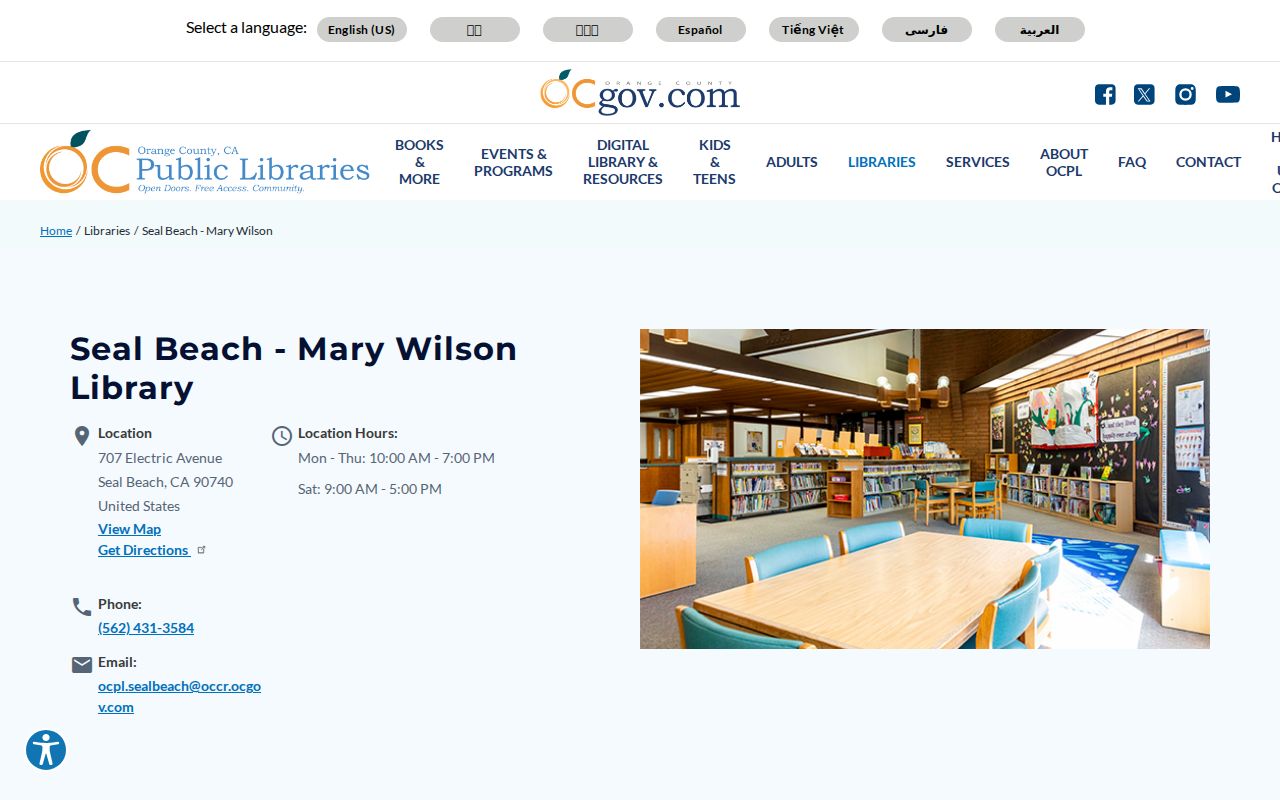
Use the branch as a catalog and research desk, not as evidence that a particular volume is on hand until the title, year, and location are confirmed.
California City Directory Sources for Seal Beach
The California State Library genealogy service is the statewide fallback for city and county directories, telephone directories, census material, newspapers, and family-history research. Search the catalog by place and publisher, then make a reference request or plan an in-person visit when a run is not digitized. A California-wide shelf can hold the regional title that never appears under a narrow Seal Beach heading.
The California State Archives county and city records guide helps separate directory research from government record research. Its record groups may lead to older county-related, naturalization, military, or governmental material. The Archives is not a promise of a Seal Beach resident index. It is a place to test the record group, agency, and time period that the local directory leaves unresolved.
Calisphere, curated through the University of California, adds photographs, maps, ephemera, and institutional collections. Search several forms of the place name, plus a street, school, organization, or business. An image can supply a building or group context, but it should not be read as a complete household list without a caption or related record.
Orange County Archives Behind Seal Beach Directories
Orange County was created from Los Angeles County in 1889. A property or family trail for land now called Seal Beach can therefore cross Los Angeles County or earlier land-grant records when the event predates the county. Orange County Archives preserves original county government records in the 1901 Old Orange County Courthouse. The Clerk-Recorder reports 640 original property-deed volumes dating from 1889 to 1926 and 210 property-index volumes from 1889 to 1953 converted to microfilm.
Most Archives holdings date before 1960. The research room is Room 108, 211 W. Santa Ana Boulevard, Santa Ana. Hours are Monday through Friday, 9:00 a.m. to noon and 1:00 to 4:30 p.m., closed from noon to 1:00 p.m.; the contact number is (714) 834-2536 and the research email is archives@rec.ocgov.com. The Orange County Archives contact information should be checked before a visit.
Seal Beach also exposes a useful municipal trail through its Laserfiche WebLink repository. Indexed or OCR-searchable agendas, minutes, ordinances, resolutions, and planning records include Planning Commission material from 1965 and records from the 1970s through the 1990s. Older scans can misread surnames and street names, so browse by document family and year as well as by keyword.
Digital Seal Beach Directory Clues
Chronicling America and the Library of Congress U.S. Newspaper Directory help identify newspaper titles and repositories even when a page is not digitized. Search surname variants, Bay City, Seal Beach, street names, civic groups, schools, and business names. Newspaper notices can reveal a move, a marriage, a death, a visitor, or a legal matter that points to the next directory year.
OCPL’s History and Genealogy resources list Ancestry Library Edition, Fold3, HeritageQuest Online, Orange County Register coverage through NewsBank from 1987 to the present, digitized newspapers, OC Stories, OC Surf Stories, and genealogy or obituary resources. Check the current OCPL resource list before assuming every collection is remote.
FamilySearch California can add county marriages, deaths, probate, and naturalization indexes, with some images subject to a free-account or FamilySearch Center or affiliate-library restriction. The released 1950 Census portal supplies a public household snapshot under the 72-year release rule in 44 U.S.C. section 2108. Population schedules through 1950 are public; the 1960 schedules are due in 2032.
Note: A digitized index may name a household, while the volume image, catalog note, or archive record supplies the context needed to judge it.
How Seal Beach City Directory Entries Read
No digitized, authoritative Seal Beach volume was available for a verified sample entry. Traditional twentieth-century city directories still provide a useful reading model, provided each symbol is checked against that volume’s own abbreviation page. Copy the title, publisher, year, page, and call number before quoting an entry, then record the exact spelling and punctuation.
| Name | Surname, given name or initial, and sometimes a spouse in parentheses |
|---|---|
| Occupation | A historical occupation or employer clue that can separate two people with the same name |
| Address | House number and street; some volumes use r for resides or rooms and bds for boards |
| Owner or renter mark | Not verified for a Seal Beach volume; check the publisher’s key before assigning this meaning |
| Widow notation | wid may identify a widow, but the exact abbreviation must be confirmed in the volume |
- Criss-cross directory
- A reverse section arranged by street and house number, then tied to an occupant or telephone subscriber.
- Householder index
- A name-based listing centered on the principal household entry; it may not list every person living at the address.
- Abbreviation key
- The publisher’s explanation of short marks such as h, r, bds, and wid; photograph or transcribe it before interpreting entries.
Owner, renter, spouse, and residence marks are not universal. A telephone subscriber may be a different household member, and an unlisted number leaves no entry. The strongest citation keeps the printed form intact and labels any interpretation as an inference.
Bay City to Seal Beach Directories
Place names are part of the search, not a footnote. The community was called Bay City before incorporation as Seal Beach in 1915. A person or street can be real, local, and absent from a search for the modern name. Test Bay City, Seal Beach, Orange County, and Long Beach-area terms, then compare the street and boundary context for the directory year.
| Era marker | Record-research meaning |
|---|---|
| 1889 | Orange County was formed from Los Angeles County, so older trails may cross county and land-grant custodians. |
| 1915 | Bay City became incorporated as Seal Beach, creating a place-name seam for directory and newspaper searches. |
| 1944 | The World War II naval installation opened; more than 300 beachside homes were removed and residents used a growing trailer park during the shortage. |
| 1957 | Hill subdivisions opened, changing the address landscape and the likely directory context. |
| 1962 | Leisure World opened, adding a large private community with its own governance and publications. |
The history markers are not verified first or last publication dates. They are search breaks. Hellman Ranch annexation expanded the city, while later development created districts whose modern street numbers did not exist in an earlier directory. When a household seems to vanish, test whether the land was still ranch, a new tract, federal property, or a changed civic boundary.
The city’s budget and history material documents the chronology of Bay City, 1915 incorporation, the naval station, Hill subdivisions, and Leisure World.
Reverse Seal Beach Directories by Address
A conventional directory starts with a surname. A reverse or criss-cross directory starts with a street and house number, then lists an occupant or telephone subscriber. That turn makes it useful for a previous-resident question, a house-history project, or a move that is easier to locate by address than by name. The exact Seal Beach reverse-directory years remain unverified, so the Mary Wilson catalog request should name this format directly.
Use a known address, check the street section, copy every nearby entry, and compare the result with the next available volume. A reverse listing can expose a name that never appears in a surname section, but a subscriber is not automatically an owner or every member of a household. Unlisted numbers and changing telephone service create silent gaps.
For present-day address-keyed records, the Seal Beach street directory is the natural handoff after the historical volume identifies a street. Keep the historical and current trails separate: one shows a dated publication entry, while the other uses modern custodians and parcel records.
Seal Beach Directory Companions
Yearbooks can bridge minors and young adults who are missing from a head-of-household listing. Ask the library to check title, school, and year rather than assuming a generic local yearbook exists. Newspaper society columns, wedding notices, school events, and business items can add a spouse, a relative, or a former address to a directory trail.
OCPL Digital Newspapers includes local titles and digitized microfilm, with some issues from the 1920s through the 1980s, but the resource is library-only. The OCPL newspaper entry point supports searches for surname variants, exact street addresses, business names, civic-club rosters, and school events. Other local community papers can add a second route, while older notices still need date and title checks.
Obituaries and probate filings can close a household trail by naming relatives and former residences. Cemetery memorials are leads, not a substitute for an official certificate or cemetery record. Compare the notice with a directory entry, census household, and any archive or county record before deciding that two people are the same.
Note: A yearbook, newspaper notice, or obituary can connect people across years, but each source has its own omissions and spelling habits.
Seal Beach Memory Collections
The Seal Beach Historical Society and Red Car Museum centers on Pacific Electric car No. 1734 at Main Street and Electric Avenue. Its local-history collections and volunteer knowledge may identify early businesses, photographs, street scenes, and residents absent from modern county portals. No official online finding aid or item-level resident-name index was located, so ask the society about a specific person, place, or image without promising directory-year coverage.
For a community-contributed visual record, the OC Stories collection identifies the contributor for each image and preserves material that formal indexes often omit. Staff can be reached at ocstories@occr.ocgov.com. Search a surname, neighborhood, street, school, or organization, then use the caption and contributor details as a lead rather than as proof of residence.
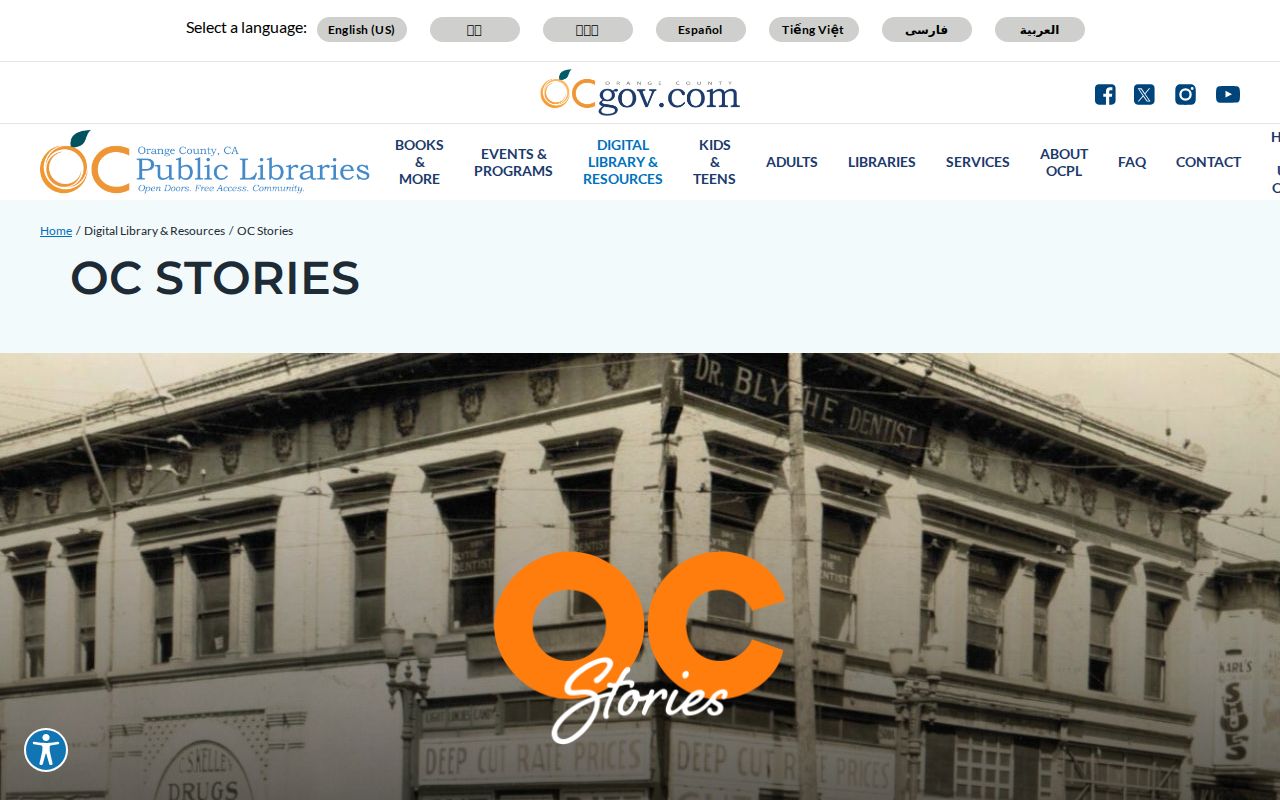
The OC Stories image is most useful when paired with a dated directory, newspaper, or city record that identifies the people or place shown.
Leisure World and the Golden Rain Foundation have private community governance and publications. Any private directory or roster is not a general public record. Public organizational contacts and community news can supply a lead, but membership or household status must not be inferred. OCPL’s library timeline records that a Leisure World branch opened in January 1963, moved in 1965 and 1973, then privatized and left OCPL in 1995. The Seal Beach branch was one of eight pioneer branches established in 1921, moved through Citizens National Bank, temporary quarters, city hall, and a location across from city hall before the present-era building in 1978, later taking the Mary Wilson name.
Trace a Seal Beach City Directory Household
Start with the strongest known year and address, not with an assumed complete run. Copy the entry exactly, record its source details, and move one available volume at a time. A Seal Beach city directory can bracket a move, while the released 1930, 1940, and 1950 census schedules can supply relationships that a directory omits. Pair the two when the boundary and household dates fit.
- Find the person in the best-supported directory year and save the title, publisher, year, page, and catalog or call-number details.
- Copy the name, initials, spouse, occupation, address, and every abbreviation exactly, then check the volume key.
- Follow the entry across the next available years, noting moves, spelling changes, cross-references, and nearby households.
- Pair each directory date with the 1930, 1940, or 1950 census and compare age, relationship, birthplace, and address clues.
- Close the trail with newspapers, obituaries, probate, cemetery records, or an archive source, labeling each conclusion by its evidence.
Disappearing from a city directory can mean a move, death, an unlisted telephone subscriber, military service, a name variation, a cross-reference, or a listing under another household member. It can also reflect enumeration timing, a new subdivision, a street change, or the Bay City and Seal Beach boundary seam. Absence alone does not prove that a household left.
When a historical entry needs a present-day identity check, the Seal Beach resident lookup can shift the question to current official records and their access limits. Keep the old entry as a historical clue, not as current information.